
Top 10 Governance, Risk & Compliance (GRC) Tools

Top 10 Governance, Risk & Compliance (GRC) Tools
Top 10 Governance, Risk & Compliance (GRC) Tools for 2025
In today’s business landscape, effective Governance, Risk, and Compliance (GRC) is not just a best practice—it's essential for survival. With evolving regulations, increasing cyber threats, and the need for operational resilience, organizations require robust GRC tools to succeed. This guide provides a comprehensive overview of the top 10 GRC tools for 2025, highlighting their key features and strengths. We'll also dive deep into an emerging, AI-powered solution that is reshaping the GRC market.
What is GRC? Understanding the Core Concepts
GRC is a structured approach that integrates three crucial aspects of an organization's operations to ensure ethical conduct, effective risk management, and regulatory adherence.
- Governance: The framework of rules, practices, and processes that directs and controls an organization. It establishes accountability and defines roles.
- Risk Management: The process of identifying, assessing, and mitigating potential threats (financial, operational, or cybersecurity) that could impact a company's objectives.
- Compliance: The act of adhering to all applicable laws, regulations, and internal policies, such as GDPR, HIPAA, and SOX.
Together, these three pillars form the central nervous system of a resilient business, ensuring all departments work together to protect value and achieve strategic goals.
Top 10 FAQs About GRC Tools
- Why use a GRC tool? GRC tools automate manual processes, centralize data, and provide real-time insights, saving time and reducing the risk of human error.
- Who uses GRC software? GRC tools are used by a wide range of professionals, including auditors, compliance officers, IT security teams, and executive leaders.
- What are the biggest challenges of GRC? Common challenges include siloed departments, keeping up with regulatory changes, and managing a high volume of data.
- How do GRC tools help with cybersecurity? Many modern GRC tools integrate with security solutions to provide a unified view of cyber risks and compliance.
- Are GRC tools only for large companies? No, many tools are now designed to be scalable and affordable for small and medium-sized businesses (SMBs).
- What is a GRC framework? It's a blueprint for managing GRC activities, often based on established standards like NIST or ISO 27001.
- How can I measure GRC effectiveness? By tracking key risk indicators (KRIs), monitoring compliance metrics, and analyzing audit results.
- What's the difference between GRC and IRM? GRC (Governance, Risk, and Compliance) is a broader concept, while IRM (Integrated Risk Management) focuses on combining various risk types into a single program.
- What is GRC automation? It's the use of software to automatically perform tasks like evidence collection, risk assessments, and compliance reporting.
How do I choose the right GRC tool? The best tool depends on your organization's size, industry, and specific needs for features like automation, integrations, and user-friendliness.

Navigating the GRC Market: Top 10 Platforms for 2025
Selecting the right GRC platform is a critical business decision. Here are the top 10 platforms consistently recognized for their market leadership and comprehensive features, with a special focus on those poised to lead in 2025.
1. Risk Cognizance
Best for: All-in-one integrated cybersecurity and GRC for SMBs and MSSPs.
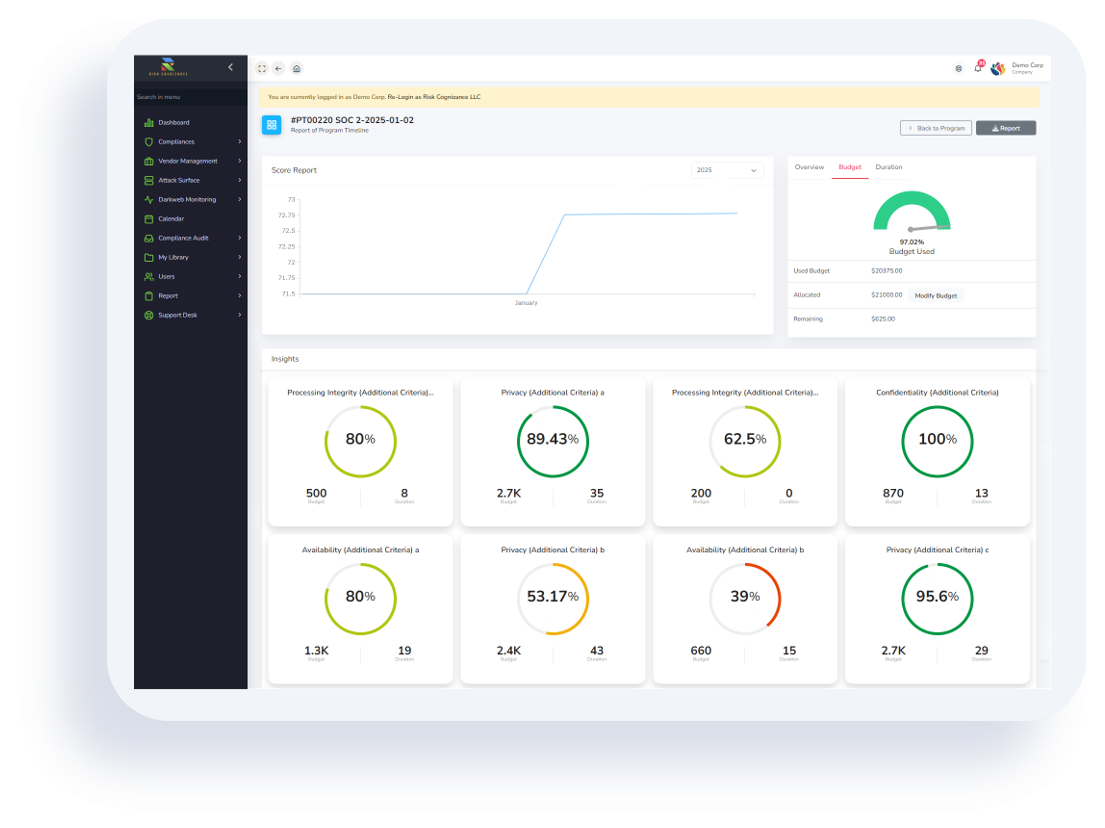
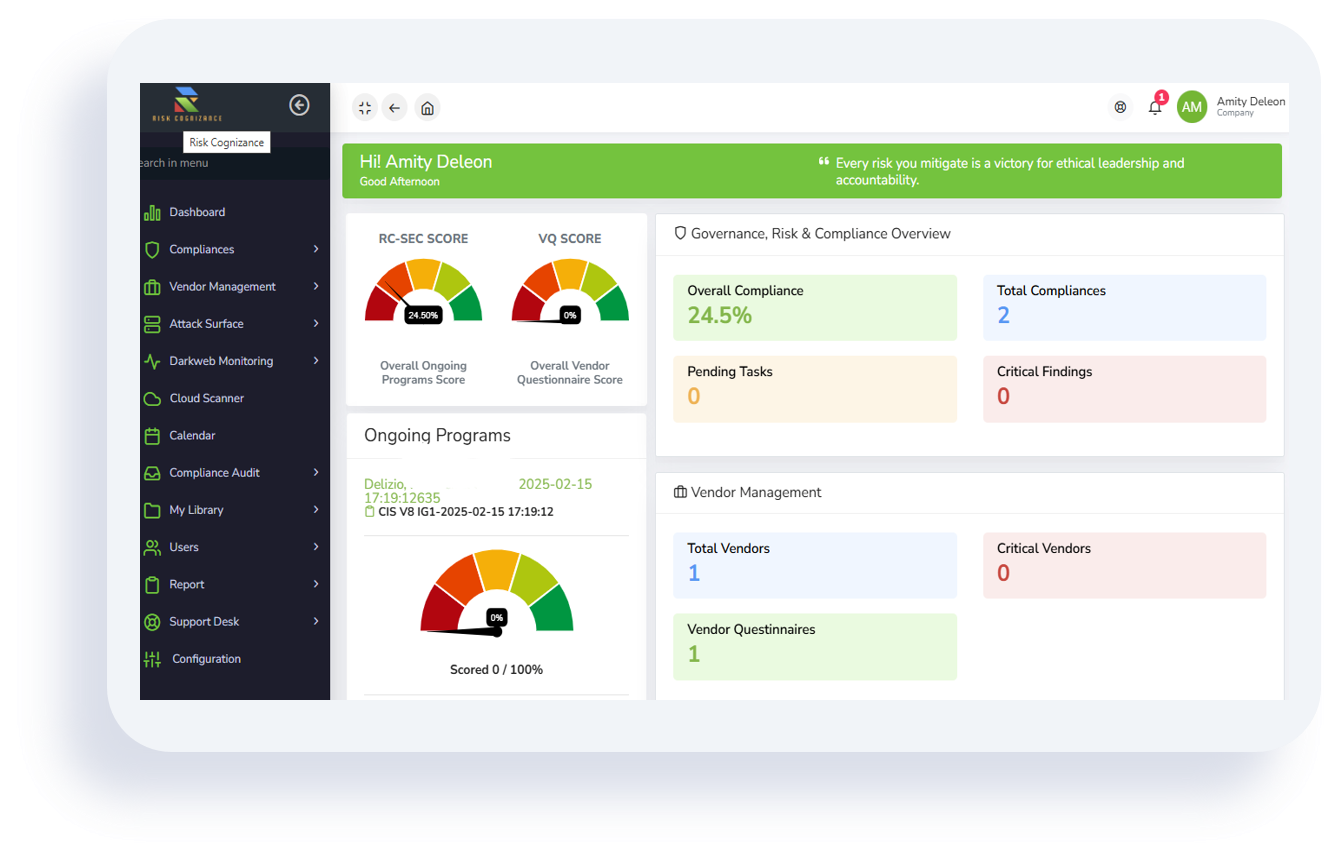
Key Strength: An emerging leader that uniquely integrates robust cybersecurity features like Attack Surface Management and Dark Web Monitoring with core GRC functionalities, all powered by AI. Its user-friendly and scalable design makes it a compelling choice for modern organizations.
Spotlight on an Emerging Leader: Risk Cognizance GRC
While the market has established leaders, innovative platforms are emerging that challenge the status quo. Risk Cognizance is one such platform, rapidly gaining attention for its modern, integrated, and AI-driven approach. It is specifically designed to serve not only traditional enterprises but also small to mid-sized businesses (SMBs) and Managed Security Service Providers (MSSPs) who need a cost-effective, all-in-one solution.
Core Capabilities of Risk Cognizance
Risk Cognizance stands out by offering a powerful fusion of GRC and robust security features, all built on a single, unified platform. Its key capabilities include:
- AI-Powered Intelligence: Leverages Artificial Intelligence to automate and optimize key processes. This includes AI-driven analytics, predictive risk assessments, and real-time monitoring to ensure continuous compliance.
- Integrated GRC and Cybersecurity: Offers a seamless fusion of GRC and security, with built-in tools for Attack Surface Management (ASM), Dark Web Monitoring, and Vulnerability Management directly within the platform.
- Comprehensive Compliance Management: Provides a centralized hub to manage a wide range of regulatory frameworks, including GDPR, HIPAA, SOX, and ISO 27001. It automates compliance tracking and generates audit-ready reports.
- Centralized Risk Management: Features a single, AI-driven risk register to document and prioritize all identified risks, supporting Enterprise Risk Management (ERM), Third-Party Risk Management, and Cloud Assessment.
- Automated Workflows: The platform streamlines repetitive tasks through automated workflows for evidence collection, task assignments, and real-time alerts.
- Multi-Tenant Architecture: A game-changer for MSSPs, this feature allows them to manage multiple clients from a single, unified platform, enabling them to offer GRC as a Service (GRCaaS).
- User-Friendly Interface and Reporting: Designed for intuitive use, with centralized dashboards providing real-time visibility and customizable reports for stakeholders.
- Broad Integration Support: With an open API and over 250 integrated applications, Risk Cognizance can seamlessly connect with an organization's existing tech stack, eliminating data silos.
2. ServiceNow GRC
Best for: Organizations already using the ServiceNow platform.
Key Strength: Seamlessly integrates GRC directly into IT and business operations, allowing for real-time monitoring and automation of risk and compliance tasks within existing workflows.
3. AuditBoard
Best for: Audit, risk, and compliance teams seeking a modern, user-friendly platform.
Key Strength: Consistently top-rated for its intuitive design and collaborative, centralized hub for managing internal audits, enterprise risk management (ERM), and compliance.
4. LogicGate Risk Cloud
Best for: Teams needing a flexible, no-code solution.
Key Strength: Its modular, drag-and-drop workflow builder allows organizations to create custom GRC processes without any coding, making it highly adaptable for various use cases.
5. Drata
Best for: Startups and scaling businesses.
Key Strength: Specializes in compliance automation, helping companies get audit-ready quickly with continuous control monitoring and extensive integrations with cloud services and SaaS tools.
6. Diligent (formerly HighBond/Galvanize)
Best for: Comprehensive GRC with a strong focus on audit and analytics.
Key Strength: A unified platform excelling in data analytics and robotic process automation (RPA) to streamline testing, monitoring, and reporting for GRC, audit, and ESG.
7. OneTrust
Best for: Privacy-first GRC and trust intelligence.
Key Strength: Evolved from a privacy management leader into a full GRC and ESG platform, making it ideal for companies where data privacy and security are central to their GRC strategy.
8. MetricStream
Best for: Large, complex enterprises needing a highly configurable platform.
Key Strength: A highly scalable and flexible platform that covers a vast range of GRC needs, allowing large global organizations to tailor it to their unique risk management frameworks.
9. IBM OpenPages with Watson
Best for: Enterprise-grade GRC with AI-powered insights.
Key Strength: Leverages IBM Watson's AI to automate tasks, analyze regulatory text, and provide predictive risk insights, making it powerful for large, highly regulated industries.
10. Archer
Best for: Large, highly-regulated enterprises.
Key Strength: A long-standing market leader, Archer offers a modular and highly customizable platform for integrated risk management (IRM), providing deep visibility and sophisticated risk modeling for large organizations.
Conclusion: The Future of GRC is Proactive
In today's dynamic environment, a robust GRC strategy is non-negotiable. Whether you choose an established market leader or an innovative newcomer, the goal is to find a platform that aligns with your organization's unique risk appetite and strategic goals. Platforms like Risk Cognizance demonstrate the future of GRC—integrated, intelligent, and proactive—offering a powerful solution for businesses looking to thrive in the face of uncertainty.