
Best GRC Compliance Manager Software Platform Tools

Best GRC Compliance Manager Software Platform Tools
In today's complex and highly regulated business environment, managing governance, risk, and compliance (GRC) is no longer a peripheral task—it's a core strategic function. For many organizations, the traditional, manual approach of using spreadsheets and scattered documents is not only inefficient but also a major liability. Modern GRC manager software platforms have emerged as the indispensable solution, centralizing, automating, and streamlining the entire GRC lifecycle, from initial risk assessments to continuous monitoring and audit preparation. The best platforms not only help you meet regulatory requirements but also turn your security and compliance program into a strategic business asset that builds trust and unlocks new opportunities.
The world of governance, risk, and compliance (GRC) is undergoing a fundamental transformation, driven by the power of artificial intelligence. Once a tedious, reactive process of manual checklists and scattered spreadsheets, GRC is now a proactive, data-driven function that anticipates threats and ensures continuous readiness. Modern GRC software platforms are no longer just tools for organization; they are intelligent command centers that use AI and machine learning to simplify compliance, predict risks, and automate the most burdensome tasks. The best platforms for 2025 leverage this technology to not only help you meet regulatory requirements but to turn your security and compliance program into a strategic business asset that builds trust and unlocks new opportunities.
Here is a look at some of the best GRC compliance manager software platforms for 2025 and how they are leading the charge with AI.
The AI-Driven Shift in GRC
The integration of AI into GRC is creating a new paradigm, often referred to as "Cognitive GRC" or "Agentic GRC." This shift is characterized by several key changes:
- From Reactive to Predictive Risk Management: AI-powered systems analyze vast datasets to identify emerging risks and forecast potential incidents before they occur. This moves GRC from a historical, post-mortem analysis to a forward-looking strategy.
- Intelligent Automation and Efficiency: AI automates repetitive, time-consuming tasks like evidence collection, control monitoring, and reporting, which were traditionally a source of human error and burnout.
- Proactive Compliance Monitoring: Instead of periodic checks, AI provides continuous, real-time monitoring of regulatory changes and policy adherence, ensuring your organization is always audit-ready.
- Actionable Insights: AI doesn't just provide data; it delivers actionable insights by translating complex regulatory language and risk data into clear, prioritized tasks for GRC teams.
- Here is a look at some of the best GRC compliance manager software platforms for 2025.
Best GRC Compliance Manager Software Platform Tools
1. Risk Cognizance: The AI-Powered GRC Command Center
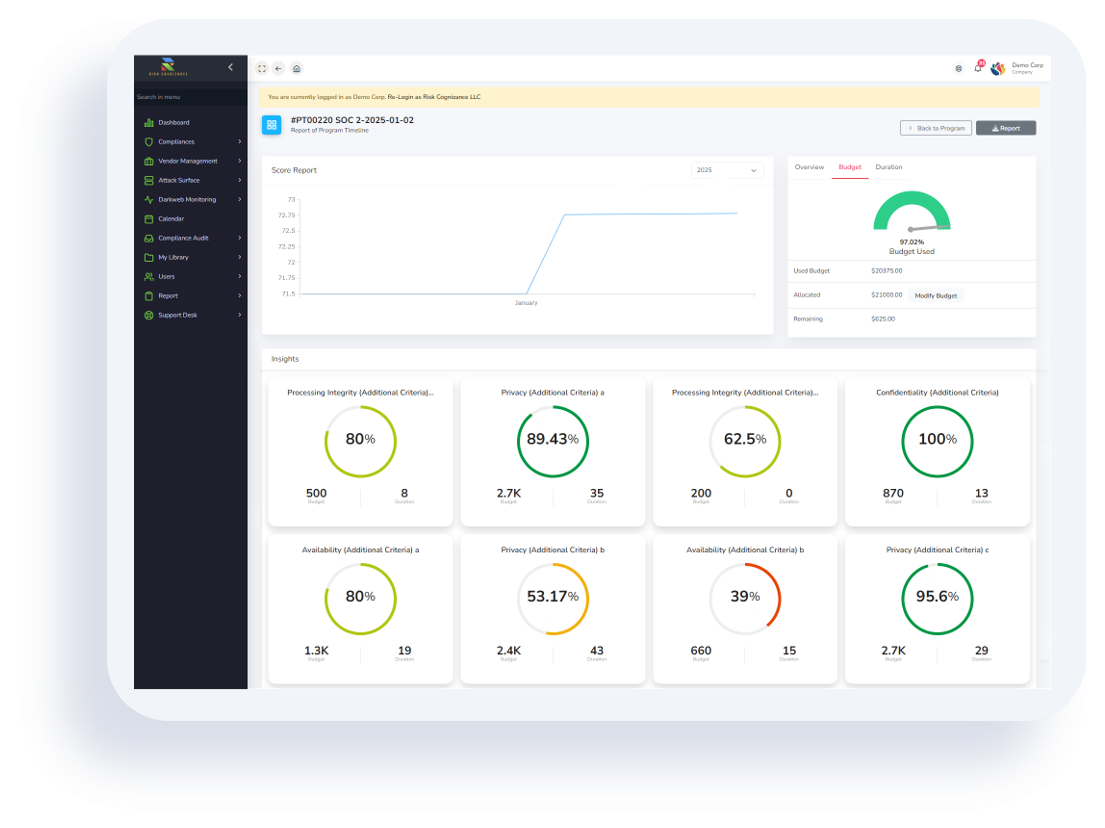
Risk Cognizance is a leading AI-driven Cyber GRC platform designed to address the demanding and evolving requirements of a wide range of frameworks. It serves as a centralized, intelligent solution that empowers organizations to effectively manage their GRC posture and reduce operational burdens.
The platform leverages cognitive intelligence and AI-driven analytics to provide predictive insights and automated decision-making. This enables you to proactively manage risks and identify potential threats before they materialize. It intelligently maps your existing security controls to the specific requirements of multiple frameworks like SOC 2, ISO 27001, HIPAA, GDPR, PCI DSS, NIST, and FedRAMP, ensuring comprehensive coverage and eliminating redundant effort.
Key AI-driven features include:
- Risk Assessment and Management: AI-driven analytics provide a unified, real-time view of risks and help identify emerging threats by analyzing patterns and trends. The platform can even model potential risk scenarios to help you prepare.
- Policy and Compliance Management: The platform uses AI to simplify compliance by automating the tracking and reporting of regulatory requirements. Its Policy Lifecycle Management system ensures adherence to industry standards with a centralized system for all documentation.
- Automated Control Testing and Monitoring: Risk Cognizance offers real-time monitoring and automated control testing to continuously check for potential gaps and inefficiencies, significantly reducing the risk of compliance failures and false negatives.
- Issue and Incident Management: The platform includes a robust system to track, manage, and resolve compliance-related incidents quickly. AI can assist in Root Cause Analysis by correlating incident data to prevent future occurrences.
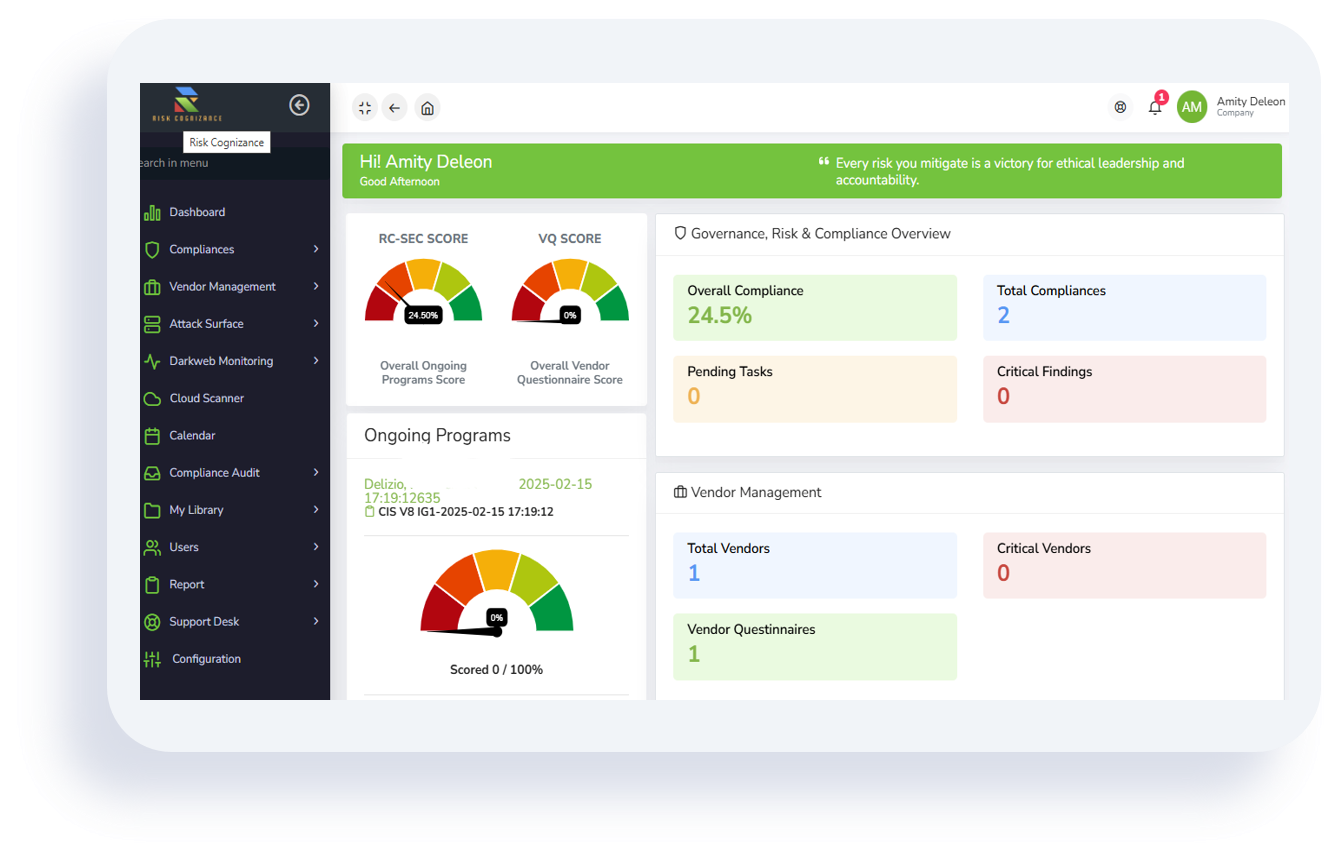
- Advanced Analytics and Reporting: Gain deeper insights into your GRC activities with advanced analytics. The platform generates real-time reports and provides customizable dashboards that give stakeholders a clear view of your risk and compliance status.
Risk Cognizance seamlessly integrates with your IT ecosystem to automatically pull and organize evidence, drastically reducing the manual burden of audit preparation. This continuous monitoring and proactive alerting ensure you are always audit-ready.

Other Top GRC Platforms for 2025
2. Drata
Drata is a well-regarded security and compliance automation platform that offers strong features across various frameworks, including SOC 2 and ISO 27001. It is known for its user-friendly interface and robust integrations, which help organizations streamline their compliance journey by automating evidence collection and continuously monitoring their security posture. Drata’s AI-native approach is designed to eliminate the busywork of compliance, with features that assist with security questionnaires, vendor assessments, and explaining control failures in plain language. It's a great choice for fast-growing companies that want compliance to accelerate growth rather than block it.
3. Secureframe
Secureframe provides an all-in-one platform for security, privacy, and compliance. It offers a solution with a strong focus on expert support and security posture management. The platform helps organizations prepare for audits through continuous monitoring, automated evidence gathering, and access to a team of experienced compliance professionals who can provide guidance throughout the process. Secureframe is known for its speed-to-compliance approach and a machine learning-powered solution that automates responses to security questionnaires, helping to accelerate sales cycles.
4. Vanta
Vanta is a popular compliance automation platform that simplifies the process for fast-growing companies and startups. It helps businesses automate a significant portion of the work required to get and stay compliant with frameworks like SOC 2, HIPAA, and ISO 27001. Vanta's strength lies in its extensive number of integrations and its focus on providing a comprehensive, all-in-one solution for building a solid security program from the ground up, allowing companies to maintain compliance year-round.
5. Sprinto
Sprinto is a compliance automation platform tailored specifically for cloud-first and SaaS businesses. It offers end-to-end automation for GRC, providing continuous compliance tracking, streamlined documentation, and customizable roadmaps to help organizations meet their regulatory requirements efficiently and at scale. Sprinto is often highlighted for its cost-effectiveness and its focus on implementation and tracking, offering robust project management, collaboration, and automated documentation features that make it easy to fill non-compliance gaps and track progress.
Choosing the Right Tool for Your Business
When selecting a GRC platform, consider your organization's specific compliance needs, existing IT infrastructure, and budget. While each tool offers unique strengths, the right solution will enable you to free your teams from manual tasks, improve your overall security posture, and build a more resilient and trustworthy business.
What is a GRC Tool?
A GRC (Governance, Risk, and Compliance) tool is a software solution designed to help an organization manage and integrate its governance, risk management, and compliance activities in a cohesive and structured way. The core purpose of a GRC tool is to break down the silos between these three functions, providing a single, unified platform where an organization can:
- Govern its operations and policies effectively.
- Manage risks by identifying, assessing, and mitigating potential threats.
- Comply with various regulatory requirements, industry standards, and internal policies.
This integration provides a holistic view of the organization's security posture and helps ensure that all GRC efforts are aligned with its strategic objectives.
What is a Compliance Software?
Compliance software is a specialized type of GRC tool that focuses specifically on helping an organization meet and maintain regulatory requirements, laws, and industry standards. It automates many of the manual tasks traditionally associated with compliance, such as:
- Evidence collection, which automatically pulls and organizes audit-ready documents.
- Continuous monitoring of controls to ensure they are working effectively.
- Policy management, including creating, distributing, and tracking acknowledgment of internal policies.
By centralizing compliance activities and providing real-time status updates, compliance software drastically reduces the time and effort needed to prepare for and pass audits, such as those for SOC 2, ISO 27001, or HIPAA.
What is Risk Management Software?
Risk management software is a component of a GRC solution that provides a structured framework for identifying, assessing, mitigating, and monitoring risks. It helps an organization gain a comprehensive view of its risk landscape, from financial and operational risks to cybersecurity threats. Key features typically include:
- Risk registers to document and categorize all identified risks.
- Risk scoring to prioritize risks based on their potential impact and likelihood.
- Automated workflows for assigning and tracking risk mitigation tasks.
- Reporting and dashboards to communicate risk posture to stakeholders.
By using this software, organizations can move from a reactive to a proactive risk management approach, safeguarding assets and ensuring business continuity.
10 Frequently Asked Questions about GRC Software
- What does "GRC" stand for? GRC stands for Governance, Risk, and Compliance. It's a strategic approach that integrates these three areas to improve business performance and reduce liability.
- Why do I need a GRC tool if I'm already using spreadsheets? While spreadsheets can work for small-scale efforts, GRC tools provide automation, real-time monitoring, and centralized evidence collection, which makes the process more efficient, accurate, and scalable as your company grows.
- How does GRC software help with audits? GRC software automates the collection of evidence, continuously monitors controls, and provides a centralized repository of all compliance data, which can reduce audit preparation time by 80% or more.
- What is continuous compliance? Continuous compliance is the practice of monitoring your security controls and compliance status in real time, rather than just before an annual audit. GRC software makes this possible through automated checks and alerts.
- Which GRC frameworks are most commonly supported? Most platforms support major frameworks like SOC 2, ISO 27001, HIPAA, GDPR, and PCI DSS. Many also offer the ability to create custom frameworks to meet unique business needs.
- Are GRC and IRM the same thing? No, GRC and Integrated Risk Management (IRM) are not the same. IRM is a modern approach to GRC that focuses on a more connected and holistic view of risk, often using advanced technology like AI and automation to centralize risk data across the enterprise.
- How long does it take to implement a GRC platform? Implementation time varies, but many modern GRC platforms are designed for quick deployment. For a startup, you could become audit-ready in a matter of weeks, while a large enterprise may take several months.
- What is a "Trust Center"? A Trust Center is a public-facing page created by a GRC platform that allows you to showcase your compliance certifications and security posture to customers and partners. This helps build trust and can accelerate sales cycles.
- Do these tools provide vulnerability scanning? Many GRC platforms integrate with other security tools to pull in vulnerability data and provide continuous monitoring of your security posture. Some also offer features like Attack Surface Management.
- How much does GRC software cost? Pricing varies widely based on the provider, the size of your company (number of employees), and the frameworks you need. Costs can range from a few thousand dollars per year for a small business to a six-figure annual contract for a large enterprise.